
04: my life had stood
meditations in an emergency, arguments for a loose hold, and an orchestra of I love you’s

meditations in an emergency
I am the stillest thing in this room. At least, that’s my endeavor.
All sounds are a whir with my eyes closed and my hearing turned inwards—the fan blasting air onto the left side of my face, the fire shooting from the burner of the gas cylinder in the kitchen, the other fan at the other end of the room creaking raggedly through a broken neck. I imagine this an interlude; an exercise in breathing and an attempt at capturing said breathing. In for as long as I can hold my breath:
in in in in in in in in in in in in in in in in in in in in in in in in in in in in in in in in in in in in in in in in in in in in in in in in in in in in in in in in in
Then:
out.
I am not trying to run through the events of the day but my mind is bad at staying still. I’m trying to relax like I imagine I am supposed to if I stay still and allow everything to loosen. In protest, a nerve whose existence was previously unbeknown to me announces itself by beating beneath the arch of my left eyebrow: I am here and I am twitching. I respond: I will not get up until you stop. The rhythm tugs me into recall.
I recall what I have just read. Levi, girls, hope, hope, hope, hopeless, wedding, terror, terror, terror. I love how she writes. I want to say what she has written is beautiful but it feels reductive, like blindness to the writing on the wall, the ache behind the words. I have opted for a restack, a heart, maybe a message later.
Still, I am still, except for the unruly nerve. My mind continues on its own adventure.
The girl who wrote it. Images slide past my mind’s eye: an open field dotted with trees, dated sometime around the beginning of the year, everything had the quality of a beginning. So, our friendship, too. Green trees, green grass, her tree in my sketchbook which I went home to paint in shades of green and yellow. The color floats me into more recent memory in form of the green tank top I’m pretending to be meditating in. The image pushes against my eyelid but I squeeze my eyes tightly and crush it.
I refuse to remember the woman at the entrance to the store shaking her head in disapproval, saying turn your back; why; they will lay allegations against you. Nor will I remember my anger or disgust at how said anger brings tears to my eyes. What is not forgotten will be my silent walk back, wishing skin could scald and that it would set the woman’s eyes on fire like a cross would a vampire.
I can hear ticking and I can’t tell if it’s from inside or outside.
Vampire. Movies. The one I was watching some minutes ago. The one I should not have been watching because I should have been studying. The music as Miles Morales leaps into a portal he definitely should not be leaping into. He should be grounded. Studying. As should I until I figure out which of the questions has a wrong answer. It is a dangerous game of probability. Probability. The Monty Hall problem. That guy was right, you should just leave.
Leave. Getting away. Who was I just speaking about this with? Desire. The desire to get away. The desire to be disliked. The woman again. Woman. Man—skip if you can’t watch this—a head smashed open by a heavy blue object. Man. Woman. Probably just as old as my grandmother before her death, limping across the floor of a church. Gun. Shots.
The twitching nerve is a rallying cry to other nerves, then muscles, bones, ligaments. Even my uterus makes an announcement, it cramps and pulls. There is not much I can do by way of acknowledgement since I am in a position already appropriate for pain: eyes shut, body still. Still, my toes curl until they find something to latch onto on the floor.
Wrong texture. Texture. Sound: metal chair screeching across the floor of a seminar room with the intent to torment. Too sensitive. To touch, sound, smell. Smell: an analgesic rubbed on someone’s back last night. Choking.
My toes pull at the plastic bag on the floor until my knees jerk. I open my eyes to find my elbows propped up at an angle against the back of the chair. No wonder I am tied up in a knot. This is no posture for a meditation.
chasing time
Outside my window is a clock in the shape of a sea of Morning Glories.
At sunrise, the white-streaked-purple petals are wide open, faces turned towards the sun, converting the field beyond my room into a sea of green and white. Late in the afternoon, when they start to close, when what lies beyond is almost entirely green grass with shrunken specks of pale, I am reminded that it is time for me to do everything I’ll never get to do.
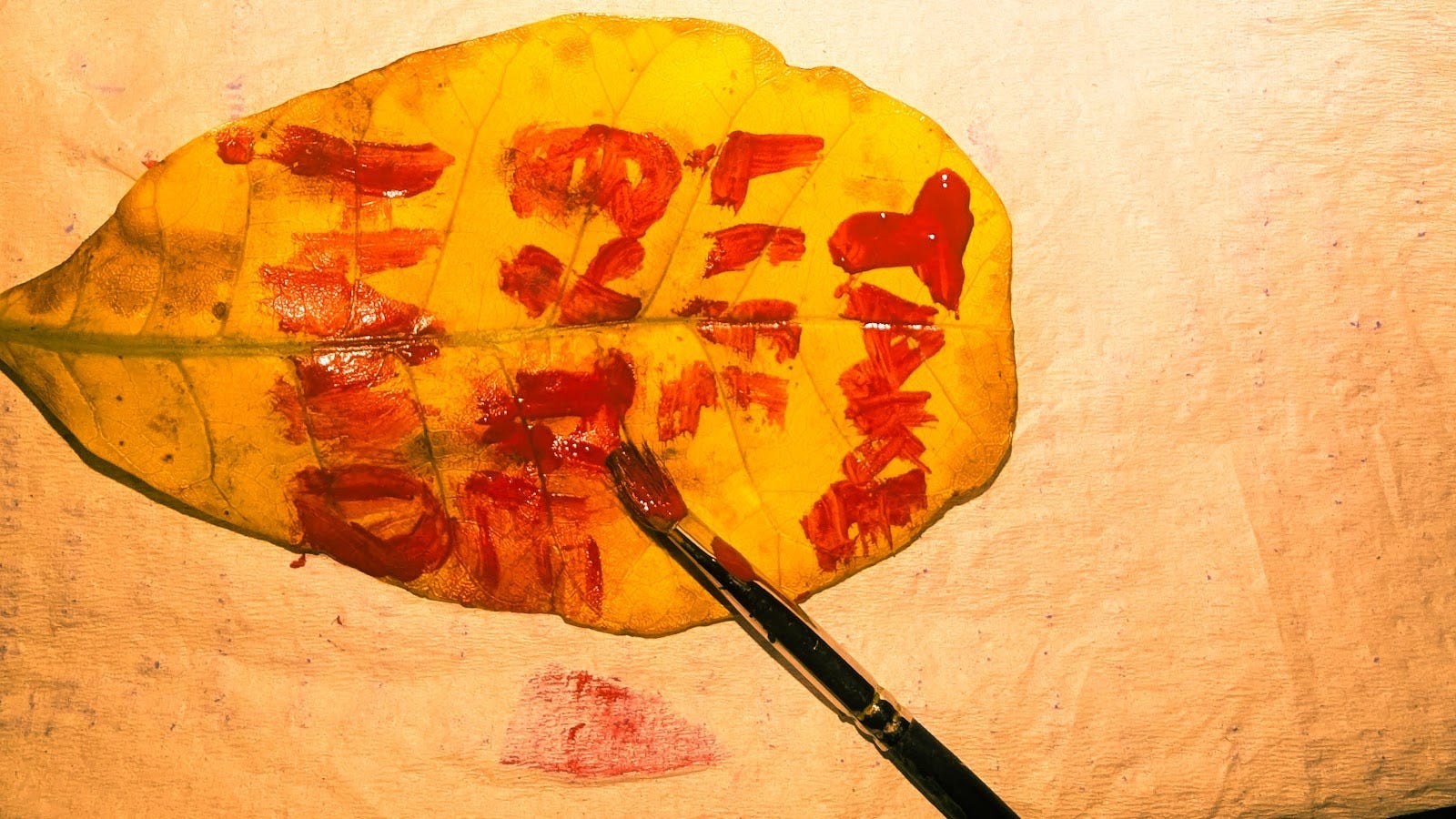
Things that feel like the 99th second of Beach Baby coming out of the cistern while you watch birds fly back home across a pink sky through your bathroom window is the title of a poem I wrote on tissue paper that no one will ever get to see. I’d stolen time to write it and then thrown it in the trash. In the same hour, I’d gone out to pick up crisp yellow leaves from underneath the False Ashoka trees that line my walking path. I painted poetry on those leaves and while, unfortunately, evidence of that exercise remains in the form of a note, all other traces of that poem are also gone.
I’d taken photos of the leaves at first and left them on my table to dry while I left the room. I came back in to find my roommate poring over them and trying to make out the words. When she was done, she advised that I continue my re-read of The Little Prince, mumbling something about its address of ephemerality. I don’t know what she means yet because—guess it, yes—I have not had time to continue the book.
However, I pondered on what she said. And I, in reflection of the I in Woolf’s A Room of One’s Own, went to sit before my own sea (of flowers) until I caught a tiny, unremarkable fish. My fish, too, skittered about and troubled the waters until I, in lieu of a conclusion, began to wonder about the link between chasing time and holding loosely the products of time spent, especially regarding the act of creation. That was what led me to deleting the photos and discarding the poems.
I’d begun this essay as a railing against the requirements of the body. But as I continued, what began as an inquiry into all the things I hold against the body descended into a different argument when all my protests (except that bit with the hormones which will be addressed, fret not) wound up in the quarters of time’s quantification.
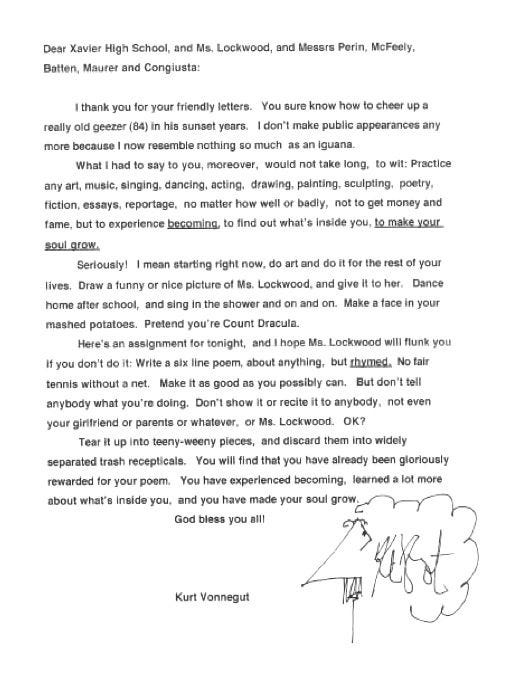
In 2006, Kurt Vonnegut replied to a letter from students of Xavier High School in New York City requesting his advice in the capacity of a famous author. After advising them to practise art in all the ways that they can, as badly as they can, and not to the end of making money from it, Vonnegut also left them with an assignment to further this direction. The task was to:
Write a six line poem, about anything, but rhymed. No fair tennis without a net. Make it as good as you possibly can. But don’t tell anybody what you’re doing. Don’t show it or recite it to anybody, not even your girlfriend or parents or whatever, or Ms. Lockwood. OK?
Tear it up into teeny-weeny pieces, and discard them into widely separated trash receptacles. You will find that you have already been gloriously rewarded for your poem. You have experienced becoming, learned a lot more about what’s inside you, and you have made your soul grow.
My poems did not rhyme because I wasn’t thinking about Vonnegut’s letter when I wrote them. But they rhymed in reason when I threw leaf and tissue in the trash.
I used to count the number of hours I spent sleeping, all the better to beat myself up because it was never short enough for the person I wanted to be. More recently, I’ve questioned what I spent the years of my life doing instead of learning the million things I want to learn now that I happen to have no time for them.
October had given me a gleeful glimpse into what a major part of my ideal day could look like: false promises of half-hours to be spent on poetry extending into wholes; terrible but joyful attempts at scansion; spontaneous combustion into lines from whatever poem I was poring over for the day (and then the week); scattered pronunciations of random words in futile attempts to decipher their primary stress. Finally, especially, every second spent from sunset till dark reading whichever poem most pinches, writing it out, rolling the words around my tongue; circling, underlining and arrowing.
Like a rubber band pulled to near its limit, reality soon snapped back in the shape of an important exam. The only way for me to continue my sunset sessions at the joy-desk was to sacrifice study, sleep, or stroll. Sacrificing my stroll was impossible and not studying would be stupid, this left me with the only option of cutting down on my sleep. Years of failed attempts at doing this taught me that it would not happen.
I’d felt like I was getting a hold of my regrets on not having started learning from my fetal life but November snatched that away. The site of shrinking Morning Glorys quickened my heartbeat. I became even more acutely aware of the passage of time. And this, I think, is how I realized why the products of spent time became so important to me.
I wanted to have something to show for every second spent. A response to how my day went, if I was in the mood for conversation, would detail every measurable action, so that even as I say that I have wasted the day, you can look at my summary and think hogwash! It’s like I’m trying to say: time is a thief but I have security.
While I can’t avoid measuring time when it comes to matters involving my education and other such commitments, I want to stop holding so tightly to the products of my creation as evidence of time well spent. I want to erase the continual fear of having wasted time by reaffirming that the feeling of time well-spent is enough.
The painting of the leaves is enough, the gentleness with which I pressed ink into tissue will have to do. I don’t have to put it on display. I’m taking back my attention for something else, like standing on the balcony before sunset to watch Morning Glories unfurl.
little mystery box
The beginning of Annalie Prime’s I Think Too Much feels very much, to me, like the first part of this letter. It also sounds like music made by a friend for a friend.
I read Henrik Karlsson’s essay relationships are a co-evolutionary loop five times in three days. One of those readings was out loud to a friend while she made sauce in the kitchen and I sat on her bed in the dark. Another was to my roommate while she stood enraptured (I hope) by her desk, looking at me.

The essay had me nodding vigorously and marveling in delight at what the author has with his wife. Karlsson captures perfectly an idea that seems so obvious it would never need saying but somehow has never been said so well: that we need others to come into our most authentic selves. The very personal nature of the essay, the frequent mentions of his life (aka Johanna) traps you in there and you don’t want to leave. The train of thoughts that led to its resolution was a lovely ride and I fell in love the more I read it.
A similar idea, and another from the same author which asks us to “treat people as capable of surprise”, strike a sonorous chord, in context closer to mine, in this essay by Agnes Ajadi.

I witnessed a spellworking one midnight a few days ago.
Jacob Collier improvised the National Symphony Orchestra with such brilliance and spiritedness for the act of music-making that it moved me to tears. To start speaking of the music would be to never stop, it would sound like silence; be brief and lengthy and heavy and light. It is incommunicable.
I wondered about the man himself and imagined if he had tried to be someone else. What a great theft of hope that would have been for all those people in the audience singing I love you over and over and for me, watching quietly; months later, oceans away.
I wondered about music, this making that I was watching, how enjoyable it was because the maker was enjoying himself. He seemed man and boy and not just because of the funky outfit he had on but also because of his enthusiasm.
About the orchestra, I marvelled at their wordless attention; their tiny inestimably precious contributions to the music as a whole; how many hours, string scars and out-of-tune notes it took for them to go off tune on request and sound so magical still. If only one flutist missed a breath or one pianist’s finger slipped, the music would sound different. This seemed an allegory for the world and how many little things we don’t appreciate it takes to keep it working.
It had me thinking about the things we tend not to think about: the waste trucks, the sewage tanks, the fishermen—all the structures maintained to our inattention. How we take for granted that there will be fish and all of our trash will be carted away.
three things about November
I finished My Liberation Notes and A helpfully suggested I add it to my non-existent list of great achievements for the year, seeing as it took me months to finish. To that, I say nothing, only that I have begun my rewatch.
I will also say that the unbelievable length of time it took me attests to my new-found depth of patience, especially when it comes to enjoying art. There were many pieces I used to promise myself I’d go back to but never did because there’s always something new ahead demanding my attention.
However, sitting with a poem or essay for weeks, a film series for months, and clicking replay immediately after the end of Across the Spiderverse; all of this has made me feel closer to the piece and allowed me explore a sea-ngular thought deeper rather than flouncing on the surface of several waters. These are works I’d like to completely unravel, to the best of my abilities, and the only way to do that is to engage with them over and over.
What I’m about to say next likely deserves an essay of its own but a quick mention here is important to this November note. I’d begun to approach conversations differently and it took me until last month to notice. I see it now less as a means to convey conclusions but rather as one to deepen thought and a huge part of that is approaching both subject and person(s) with openness even when you think you’ve known them long enough to read them like the palm of your hand. I’m trying to include more uncertainty in my approach to dialogue even with the people closest to me. It’s more enjoyable and more rewarding this way.
I shared, publicly again, after a while, my photography. The making of it was most stressful because it was different from anything I’d ever done but most enjoyable. It was also cathartic because while the physical making began only months ago, the mental making, in a way, has taken over a year, and that subconsciously.
PS: meditations in an emergency is the title of one of my favorite poems (by Cameron Awkward-Rich).
With love,
S.
oh Sekinat.